
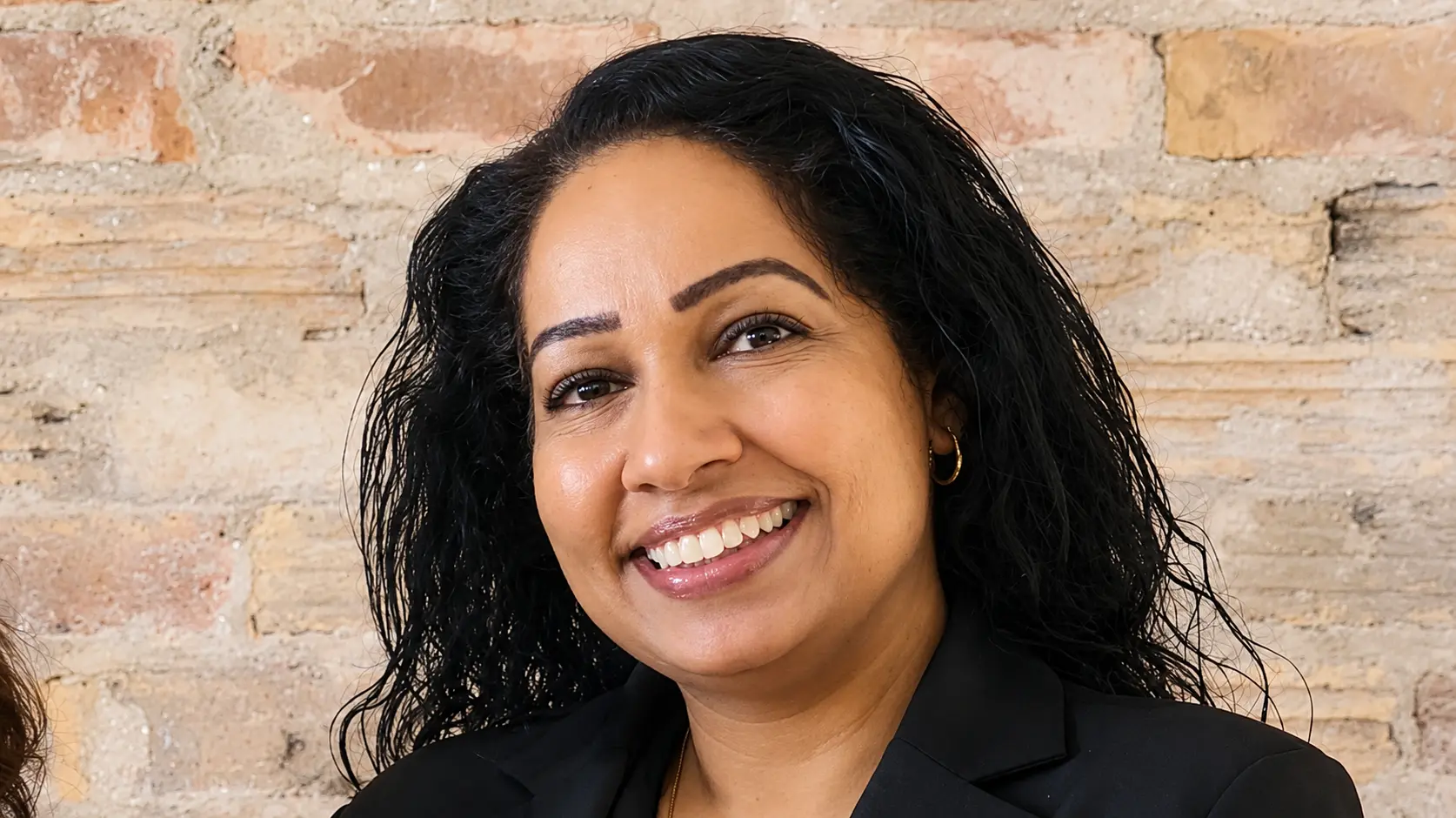
Continuing our Q&A series, Demi got to sit down with internationally trained lawyer and qualified mediator, Razia Husain!
At our office since September of 2023, Razia brings with her a wealth of knowledge and a cultured perspective derived from her time learning law in the U.K.
Having practiced law in Ontario for a couple of years, Razia specialized in services for women who had experienced violence. Now back in Saskatchewan, Razia is putting her skills to use in family law.
Razia’s role has also expanded to include being a principal for articling student Laura Chartier, showcasing her expertise in the field of law and knack for teaching.
Lets dive in to the interview!
Interviewer: So tell me a little bit about your educational background.
Razia: For sure, so originally I did my undergrad at U of S, I did psychology. And then I decided that I wanted to further my education. And I went to British Columbia, where I did my master’s. It was a combination of interdisciplinary studies, a combination of psychology and gender studies. And then from there, I was actually with the government for a couple of years. And then I just decided I needed to change careers altogether, and I decided to go back to school, and specifically for law school. So I did my law school in the UK came back, did my NCAs. And then I actually moved out to Ontario, where I wrote my bar exam, and I started practicing for a couple of years, and then I decided to come back to Saskatchewan and then here I am.
Interviewer: Wow, that’s incredible. So what are some of the key differences you’ve noticed about the practice of law in Saskatchewan as compared to Ontario?
Razia: I think for me, it’s just minor things. I think the biggest thing is just when it comes to property, so obviously property is legislated by each province. So there’s going to be a little bit of differences, so even though I was practicing an Ontario with a clinic that I was working in. We didn’t do a lot of property because it was a clinic. So a lot of it was just more about child support, parenting time, those type of matters and then a lot of my work was primarily in immigration. So coming here was amazing because it just kind of gave you the full breadth of a lot of areas. Kind of really getting into kind of the different areas, especially with the full array of family law that we’re practicing. So it’s been a little different, but in a good difference.
Interviewer: Would you rather always have to wear wooden clogs or always have to wear a sombrero?
Razia: I would say a sombrero I feel like it provides a little whimsy, you’re always protected from the elements you can do more, I feel like the wooden clogs would just give me splinters. And I feel like you can’t really do anything in clogs, at least in a sombrero, you’ve got some options there.
Interviewer: What were some of the mindset shifts that you had after taking the collaborative law training?
Razia: Yeah, I think it just gave me a different like way of thinking of things, right. And collaborative law is something that I always found really interesting even in Ontario, like I know there are a lot of big firms there, but I never just ended up working in that area and so coming here, what I really enjoyed is getting a full understanding of what collaborative law means, right, so the fact that you can sort of where you’re working together the way that you can bring in outside people that can support the families, whether it’s a financial neutral, whether it’s a counselor right, it’s that cohesive, sort of interactive of let’s work together to solve this. How can we as a group work with trying to work together on things right? So I think for me, it’s just getting a better understanding of the collaborative law process, what it is the benefits of it, how it can actually really be helpful for a lot of families that are currently going through conflict.
Interviewer: What interested you about the practice of family law?
Razia: I think for me, it’s just sort of working with people, empowering clients, helping them go through crisis, right? And I think for family, all what I really like is that I think sometimes there’s such a negative connotation. When it comes to family law like the only way you have to go is through court right, and it’s this high conflict and sadly, yes, there are situations of where that can happen, but it’s also working with clients to help them understand that there’s other options, right, that you guys can work together. There are ways for us to do that, right. And at the end of the day, especially if there are children, for example or pets, sort of putting their best interests at the central part and sort of helping clients navigate that road, whether it’s us representing them, supporting them, or if empowering them, to sort of understand and sort of support them through that process.
Interviewer: Who’s better Wonder Woman or Supergirl and why?
Razia: I would say, probably Wonder Woman, and the only reason I say that is I’m biased, because I think, just remembering as a child playing with my Wonder Woman, figurine and I had her, and I loved her, and I would have her fight. He-Man, my brothers, my older brothers one, so I would say Wonder Woman in that situation.
Interviewer: So now that you are a principal, what’s something that you’ve learned through the journey of supervising an articling student?
Razia: Yeah, I mean, I think it’s, it’s an interesting journey, I think like I’ve had students in the past when I was in Ontario, but to me, like a full on full articling principal, it’s definitely a teaching moment for me. I think it’s a good way for helping me to kind of take a step back and try to remember my own articling to be like, what would I have wanted to have happen? What did I need at that time? What would be helpful for me. So I think for me, it’s just trying to like put myself back to that place and be, like, how can I be supportive to any student right? Specifically to my articling student. How is it that I can also be better as a practitioner, right?
Interviewer: What’s one piece of advice you have for your past-self regarding the practice of law?
Razia: Oh, boy, many, many I mean I don’t know, that’s a really good question. I think for me, like I always knew it would be a journey, and some of the practitioners I worked with, like, were really phenomenal like they were very learned, but they were very humble. And that’s always stuck with me of how they would always be like, you know that you think you know everything, you really don’t, you’re in trouble. But I think it’s finding that confidence and sometimes in our field, the imposter syndrome is so quick to come out. Really in any area, whether you’re working only mediation, or you’re working a lot, everything, it’s just that nuanced of like, do I know enough, but I don’t know enough right? And sort of I think trying to find that fine line of like, okay, I do know some things, but also sort of I think reinforcing your knowledge base, right? And sort of recalibrating, and being like, no I do know this, but it’s good to learn more to have a better understanding, because I think then you’re always open to learning. I think if you come to that point of where you think, you know everything, I think that can be a slippery slope into where you really aren’t hearing, and you’re not understanding so.
Interviewer: Country music, thoughts?
Razia: Well, I don’t want to offend anybody, so I will just say not usually my cup of tea and I respect everybody else and their choice of music. I’m pretty eclectic, I love my 2000s R&B and hip-hop, a lot of the pop stuff from the 2000s so even like the old 80s rock, like kind of eclectic in that area. So The full array.
Interviewer: Why should somebody choose Panko Collaborative Law for their legal matter?
Razia: Well, I think the biggest thing is of the way that our firm looks at everybody. It’s about how can we help you? How can we help you through this journey, whether it’s us representing you fully or it’s us supporting you, if you’re choosing to be a self rep. How can we support you right? And I think looking at how we all work together? As a team, I think that’s a really good reflection of how we all work with sort of our clients as well is we’re there to support you. We’re going to work together. We’re going to help you out. I think the other area that I would stress upon is that our focus is collaborative, right? We’re not a traditional litigation firm, and I think, sometimes when I’ve had clients come in, that’s what’s drawn them to us, right, it’s like it’s not just you have to go to court. If we need to, yes, we can take you there. However, our goal is to say, okay, what is your issue, let’s talk about it. What are other ways? Because I think people often forget that there are other means right, and they also sort of don’t understand that litigation is not fun.
We hope you have enjoyed this spotlight on Razia Husain. Razia is available for new client consultations and also contracts through CommonSense Mediation to provide mediation services as a qualified mediator. If you would like to work with Razia, contact our office today to book a consultation:
If you want to learn more about Razia, make sure to visit her profile page!